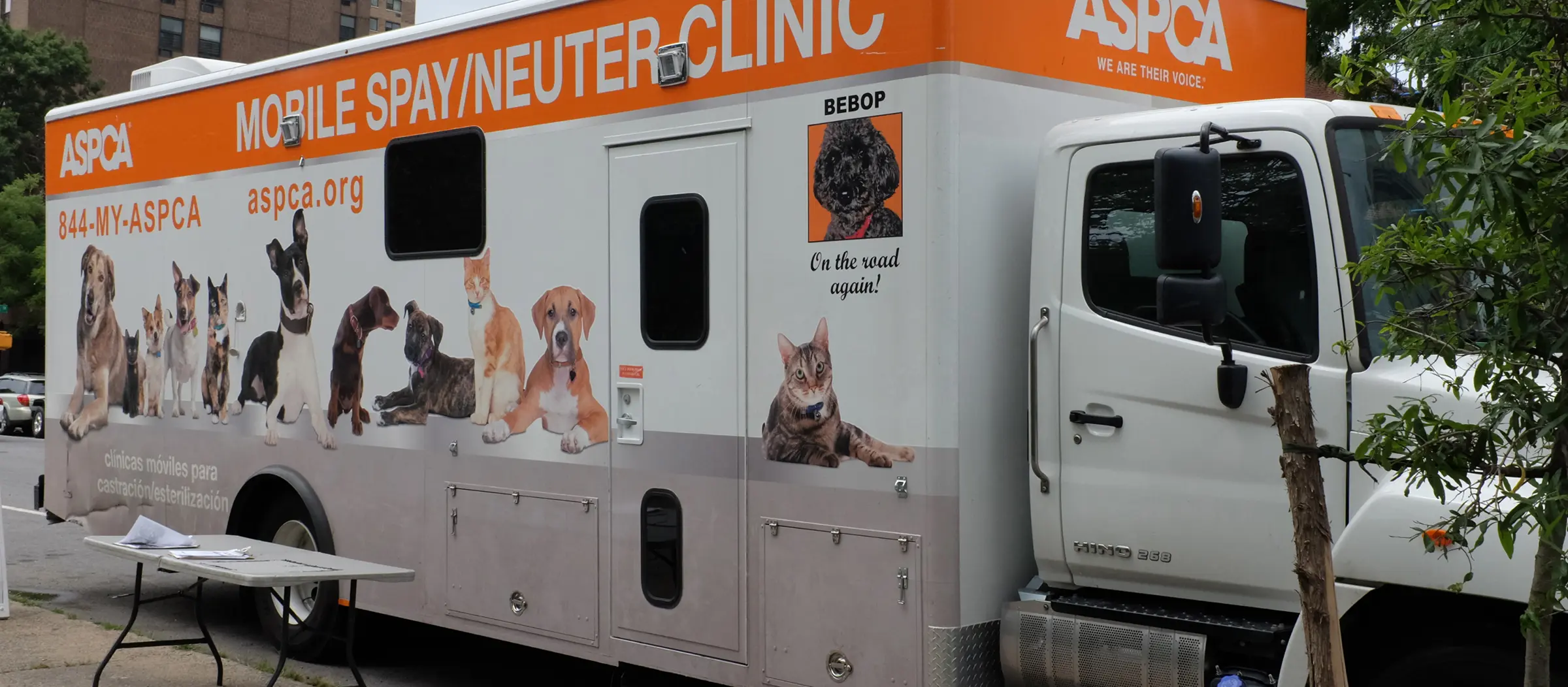
ASPCA Los Angeles Spay/Neuter Clinic
Services & Pricing
We provide spay/neuter surgery for cats and dogs throughout Los Angeles.
Eligible Residents
Included:
- Small tattoo, placed close to the incision site to indicate the animal is spayed/neutered
- E-collar (plastic pet cone to prevent your pet from licking their incision)
Residents of the City of Los Angeles who do not reside in the above zip codes may still be eligible for services at our clinic with a spay/neuter voucher. A voucher can be obtained from the Free or Discounted Spay & Neuter Certificate Program.
Additional Services:
Please note — we only provide additional services to animals who are undergoing spay/neuter procedures.
- FVRCP vaccine for cats; DA2PP vaccine for dogs
- Nail trim
- Microchip $10
What to Bring:
- Your Free or Discounted Spay/Neuter Certificate from the City of Los Angeles.
- Photo identification showing you are 18 years of age or older
- Proof of address: Driver license/ID, Rent/Gas/Electric/Cable bill
- If transporting a pet for someone who is disabled or elderly, bring that person's proof of public assistance and photo identification.
Step 1:
Sign Up below to get on the Same-Day Waitlist
At 6 a.m. on the day of the clinic you wish to attend
Step 2:
Wait for Confirmation
Please only make your way to the clinic once you’ve received a confirmation text. Signing up does not guarantee a spot
Step 3:
Arrive at the Clinic
Keep your cell phone nearby for further instructions
Step 4:
Surgery Intake
We will admit your pet to the clinic
Step 5:
Return That Afternooon
Your pet’s surgery will be complete and ready to return home!
Location
1850 West 60th Street, Los Angeles, CA, 90047
Located next door to the Chesterfield Square/South L.A. Animal Services Center.
.webp)
How to Access Spay/Neuter Services:
For dogs and cats:
Our clinic uses an online waitlist system that opens each morning for same-day spay/neuter surgeries. Although we do our best to serve all clients that arrive at the clinic with a waitlist reservation, this is not a guarantee of services. Check-in begins at 7 a.m. and pick-up is between 2:30 p.m. on the same day.
Sign up on our online waitlist Monday through Friday, starting at 6 a.m. on the same day that you want to bring your dog or cat for spay/neuter.
- Take a brief survey to ensure you are eligible for ASPCA spay/neuter services.
- If you are eligible, you may add up to two pets to the waitlist. You must be on the waitlist to receive spay/neuter services. This is not an appointment or guarantee for services.
- Once your survey is complete, you will receive a confirmation text message with further instructions.
If you cannot access the system, we may be full for the day or we are not currently open.
FAQs
We continue to experience high demand for our services and capacity at our mobile spay/neuter clinics is limited. For other low-cost spay/neuter options, please refer to the Human Animal Support Services.
You can buy or renew a dog license (tag) at your local veterinarian’s office, at the Miami-Dade Animal Services shelter or at any of the 311 Service Centers. Dog licenses are required for all dogs over 4 months of age in Miami-Dade County. Cats are not required to have a license in Miami-Dade County. For more information, call 311 or visit the Miami-Dade Animal Services website.
Please note that if you elect not to purchase a dog license within 30 days of your dog receiving a rabies vaccine, you may be subject to civil penalties by Miami-Dade County. The ASPCA is not responsible for any fines incurred.
The ASPCA Community Veterinary Clinic offers dog licenses (tags) to Miami-Dade County residents as a courtesy to our clients:
- No appointment needed.
- Must have proof of current Rabies vaccination.
- Must present a valid driver's license or passport.
- Miami-Dade County residents who receive public assistance may be eligible for a discounted license (tag). To qualify for the discount, pet owners must provide a current eligibility letter from at least one of the following: SNAP, Medicaid, Supplemental Security Income (SSI), Jackson Memorial Hospital Clinic Cards, Temporary Assistance for Needed Families (TANF).
If your pet is experiencing a medical emergency, please call your nearest veterinary emergency hospital immediately.
If you suspect your pet may have been poisoned or ingested a toxic substance and you are not sure whether it is a medical emergency, you may call the ASPCA Animal Poison Control (APC) for assistance. APC is a national telephone hotline, available 24 hours a day, seven days a week. It is staffed by veterinarians and board-certified veterinary toxicologists. A consultation fee may apply. Call (888) 426-4435 for assistance.
For additional information about finding emergency care for your pet, please visit our Emergency Care page.
To protect your pet from dangerous diseases they could contract from the environment or other animals, the ASPCA recommends vaccinating cats according to the schedule below. Your veterinarian may suggest additional vaccines based on your pet’s risk of exposure.
- 2 Months Old: FVRCP (Feline Viral Rhinotracheitis, Calicivirus, Panleukopenia)
- 3 Months Old: FVRCP and Rabies*
- 4 Months Old: FVRCP
- 1 Year Later: FVRCP and Rabies* (Ask your vet for a 3-year vaccine)
- 3 Years Later + every 3 years thereafter: FVRCP and Rabies*
*Rabies Vaccine: Required by state law. Some vaccines are effective for only one year. Be sure to request 3-year vaccines from your veterinarian.
Tip: Bring your pet’s vaccination records with you to the veterinarian to ensure they receive their vaccinations at the proper time.
Have a cat over 4 months old with no history of vaccines?
- Unvaccinated cats 4 months of age and older should receive a rabies vaccine and two FVRCP vaccines 3-4 weeks apart.
- After the initial set of vaccines, each vaccine should be given again 1 year later and then every 3 years* after that.
To protect your pet from dangerous diseases they could contract from the environment or other animals, the ASPCA recommends vaccinating dogs according to the schedule below. Your veterinarian may suggest additional vaccines based on your pet’s risk of exposure.
- 2 Months Old: DA2PP (Canine distemper, Adenovirus 2, Parvovirus, Parainfluenza)
- 3 Months Old: DA2PP and Rabies*
- 4 Months Old: DA2PP
- 1 Year Later: DA2PP and Rabies* (Ask your vet for a 3-year vaccine)
- 3 Years Later + every 3 years thereafter: DA2PP and Rabies*
*Rabies Vaccine: Required by state law. Some vaccines are effective for only one year. Be sure to request 3-year vaccines from your veterinarian.
Tip: Bring your pet’s vaccination records with you to the veterinarian to ensure they receive their vaccinations at the proper time.
Have a dog over 4 months old with no history of vaccines?
- Unvaccinated dogs 4 months of age and older should receive a rabies vaccine and two DA2PP vaccines 3-4 weeks apart.
- After the initial set of vaccines, each vaccine should be given again 1 year later and then every 3 years* after that.